Circular Infographic with Six Options: A Modern Tool for Clear Communication
In today's fast-paced world, the ability to convey complex ideas quickly and effectively is more important than ever. One powerful tool that has gained popularity in recent years is the circular infographic. These visually engaging designs are ideal for presenting processes, workflows, and business strategies in a clear and professional manner. Whether you're a business professional, educator, or marketer, understanding how to use and benefit from circular infographics can enhance your communication efforts significantly.
What Is a Circular Infographic?
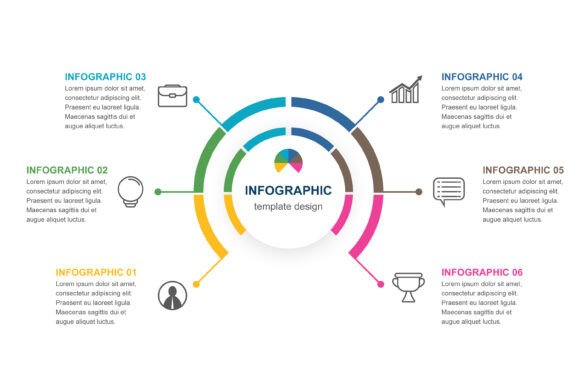
A circular infographic is a type of visual representation that uses a circular layout to display information. Unlike traditional linear infographics, which follow a straightforward path, circular infographics allow for a more dynamic and interconnected presentation of data. This format is particularly useful when illustrating processes that have multiple steps, feedback loops, or interrelated components.
The design typically includes vibrant colors, icons, and text elements arranged in a circular pattern. This not only makes the information more visually appealing but also helps in retaining the audience's attention. The six options mentioned in the description refer to different layouts or variations of this design, each tailored to suit specific needs and preferences.
Why Use a Circular Infographic?
There are several reasons why businesses and educators are turning to circular infographics. One of the main advantages is their ability to simplify complex concepts. By organizing information in a circular format, it becomes easier to see how different parts of a process or strategy connect. This is especially helpful when explaining workflows, project timelines, or decision-making processes.
Another benefit is the visual appeal. With vibrant colors and icons, these infographics are not only informative but also engaging. They can be used in presentations, reports, and marketing materials to capture the audience's interest and make the content more memorable.
The Purpose and Significance of Circular Infographics
The primary purpose of a circular infographic is to communicate ideas clearly and efficiently. In a business context, this could mean presenting a company's strategy, outlining a product development process, or illustrating customer journey maps. For educators, it might involve explaining scientific concepts, historical events, or mathematical theories in a way that's easy to understand.
These infographics are significant because they cater to different learning styles. Visual learners, in particular, benefit from the use of images and diagrams, as they help in better comprehension and retention of information. Moreover, in a digital age where attention spans are short, the visual nature of circular infographics ensures that the message is delivered quickly and effectively.
Practical Relevance in Modern Life
Circular infographics have practical applications across various fields. In the business world, they are often used in presentations to showcase key performance indicators (KPIs), organizational structures, or market trends. Their ability to present information in a structured yet creative way makes them an excellent tool for decision-makers and stakeholders.
In education, teachers can use circular infographics to break down complex subjects into digestible pieces. For example, a science teacher might create a circular infographic to explain the water cycle, while a history teacher could use one to illustrate the causes and effects of a major event. This approach not only enhances learning but also makes the subject matter more engaging for students.
How to Choose the Right Circular Infographic
When selecting a circular infographic, it's important to consider the specific needs of your audience and the purpose of the content. The six options mentioned in the description likely include different layouts, color schemes, and icon sets, allowing users to choose the one that best suits their requirements.
For instance, if you're creating an infographic for a corporate presentation, you might prefer a more professional and minimalist design. On the other hand, if you're designing for a younger audience or a creative project, a more colorful and playful layout could be more appropriate. Understanding the target audience is crucial in determining the right style and format.
Common Misconceptions About Circular Infographics
Despite their many benefits, there are some common misconceptions about circular infographics. One such belief is that they are only suitable for certain types of content. However, this is not the case. Circular infographics can be used to represent a wide range of information, from simple processes to complex systems.
Another misconception is that they are difficult to create. While designing a high-quality infographic requires some skill, there are numerous tools and resources available that make the process accessible even for beginners. Many platforms offer templates and drag-and-drop features, allowing users to create professional-looking infographics without any prior experience.
Enhancing Communication with Circular Infographics
One of the most valuable aspects of circular infographics is their ability to enhance communication. Whether you're presenting to a team, teaching a class, or pitching an idea to a client, these visuals can help you convey your message more effectively. By breaking down information into manageable segments, they reduce the cognitive load on the audience and make it easier to absorb the content.
Additionally, circular infographics can be used to highlight key points and emphasize important details. This is particularly useful in marketing materials, where the goal is to capture attention and drive action. A well-designed infographic can guide the viewer through a story or a process, making the information more compelling and persuasive.
Choosing the Right Format for Your Needs
The description mentions that the collection includes AI, EPS, and JPEG formats. Each of these file types has its own advantages and use cases. For example, AI (Adobe Illustrator) files are ideal for editing and scaling, making them perfect for designers who need to make adjustments. EPS (Encapsulated PostScript) files are also scalable and are commonly used in print media. JPEG files, on the other hand, are widely supported and suitable for digital use, such as websites or social media.
Understanding the differences between these formats can help you choose the one that best fits your needs. If you're planning to use the infographic in a presentation, a JPEG might be the most convenient option. However, if you're working on a project that requires further customization, an AI or EPS file would be more appropriate.
Conclusion
Circular infographics with six options offer a versatile and effective way to communicate complex ideas. Their visually appealing design, combined with the ability to present information in a structured and engaging manner, makes them a valuable tool for businesses, educators, and creatives alike. Whether you're looking to improve your presentations, enhance your teaching methods, or create compelling marketing materials, these infographics can help you achieve your goals.
By choosing the right layout, format, and design, you can ensure that your message is delivered clearly and professionally. As the demand for visual communication continues to grow, embracing tools like circular infographics can give you a competitive edge in today's dynamic environment.
Thank you for choosing our shop, CLton Studio. We are committed to providing high-quality resources that empower your creative and professional endeavors.